Travel Guide
03
Jul
Devrent Imagination Valley: Cappadocia's Surreal Natural Sculpture Gallery (2026)
Bottom Line Up Front: Devrent Valley, known to locals as Hayal Vadisi (Imagination Valley), is unlike any other landscape in Cappadocia. There are no rock-cut churches here, no frescoes, and no underground cities. Instead, you walk into a natural sculpture gallery where 60 million years of volcanic activity and erosion have carved the soft tuff into shapes that look uncannily like animals, figures, and mythical creatures. A camel kneels in the rock. A dolphin arches mid-leap. A seal balances on a stone pedestal. A pair of birds appear frozen in a kiss. Devrent does not ask you to understand history — it asks you to see it. Located just 7 kilometers from Goreme on the road to Avanos, this free-entry valley is a highlight of the Red Tour and one of Cappadocia's most joyful, family-friendly experiences.
Quick Facts: Devrent Imagination Valley
| Location | Avanos road (D302), ~7 km northeast of Goreme, ~5 km southeast of Avanos |
| Entrance Fee | Free — no ticket, no gate, open 24 hours |
| Time Needed | 45 to 75 minutes for a full exploration; 30 minutes for a quick photo stop |
| Best Time to Visit | Mid-morning to midday (10:00 AM–1:00 PM) for seeing shapes clearly; early morning (8:00–9:00 AM) for solitude |
| Nearby Attractions | Pasabag Monks Valley (3 km south), Zelve Open-Air Museum (4 km east), Avanos pottery workshops (5 km northwest) |
| Best For | Families with children, photographers, Red Tour travelers, anyone who enjoys playful discovery |
| Facilities | Small parking area, souvenir stalls at the entrance (no cafes or restrooms inside the valley) |
Why Devrent Valley is Different — No Churches, Pure Geology
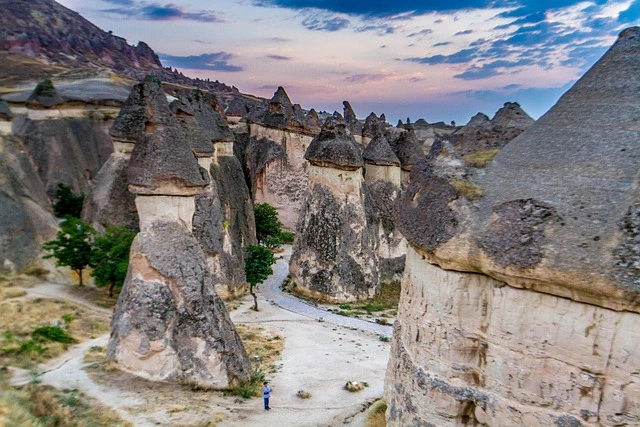
Every other major valley in Cappadocia — Goreme, Zelve, Ihlara, Soganli — is defined by its rock-cut churches. Frescoes of saints, carved altars, monastic dining halls carved into the stone. These are the sites that earned Cappadocia its UNESCO World Heritage inscription in 1985. But Devrent Valley broke the mold entirely. It contains zero churches. Zero frescoes. Zero religious carvings of any kind. Walk the entire length of the valley and you will find not a single cross etched into the tuff. And this absence is precisely what makes Devrent so special.
The valley's geological formations were simply too soft, too irregular, and too unstable for the Byzantine monks who carved Cappadocia's other valleys into thriving monastic communities. The tuff here is unusually friable — it crumbles under pressure in ways that the more compact formations at Goreme and Zelve do not. Rather than seeing this as a limitation, visitors experience it as liberation. Without the solemnity of sacred spaces, Devrent becomes a playground. Without the hushed reverence of churches, it becomes a place where children run ahead shouting "I see a camel!" and adults — freed from the pressure to be serious — do exactly the same thing. In a region dense with heavy history, Devrent offers lightness. It is Cappadocia's smile.
The valley floor is relatively flat and compact, stretching approximately 1 kilometer from end to end, with formations clustered on both sides of a shallow gully. The total walking distance to see everything properly is under 2 kilometers round trip — easy for all fitness levels and accessible to children as young as four or five. A loop path circles the main formation field, and while the ground is uneven in places with loose volcanic gravel, no serious hiking or scrambling is required. Comfortable walking shoes are sufficient; hiking boots are not necessary unless you plan to explore the more rugged outer edges of the valley.
The Famous Camel Rock and Other Zoomorphic Formations
Devrent Valley contains Cappadocia's richest concentration of zoomorphic rock formations — natural shapes that, through the random interplay of volcanic deposition and differential erosion, have come to resemble animals, figures, and objects. Here is a guide to every major formation, so you know exactly what to look for when you arrive.
The Camel (Deve Kayasi)
The undisputed star of Devrent Valley and the most photographed formation on site. The Camel Rock, known in Turkish as Deve Kayasi, stands near the entrance to the valley and is impossible to miss — a full-bodied dromedary shape complete with a long neck, a distinct head with a recognizable muzzle, and the characteristic hump that makes the identification immediate and unmistakable. The camel appears to be kneeling or resting on the ground, its neck stretched forward as if surveying the valley. This formation alone draws thousands of visitors annually and appears on nearly every piece of Cappadocia tourism material. Park staff and local guides have placed a small descriptive sign at the base. For the best photograph, stand approximately 20 meters to the southeast — the morning light catches the camel's "face" from this angle and the sky provides a clean background with no distracting modern elements in the frame.
The Dolphin
About 100 meters past the Camel, on the right-hand side of the main path as you walk deeper into the valley, a slender rock column arches upward and forward with a curve that is startlingly dolphin-like. The "snout" points toward the sky, the body tapers into what reads unmistakably as a tail, and the entire formation captures the frozen motion of a dolphin breaking the surface of the sea. This is one of the most remarkable illusions in all of Cappadocia — a marine mammal sculpted by volcanic ash and wind, standing 800 kilometers from the nearest ocean. The Dolphin is best viewed from directly in front, facing west, where the silhouette reads most clearly against the sky.
The Seal
Further along the main path, perched atop a low pedestal of tuff, sits the formation locals call the Seal. A rounded, smooth boulder of darker basalt balances on a narrow neck of lighter tuff, creating the unmistakable silhouette of a seal balancing a ball on its nose — a classic circus pose frozen in stone. The "ball" is actually a basalt capstone that once protected the softer column beneath it from erosion, the same geological mechanism that created all of Cappadocia's fairy chimneys. Here, the proportions happened to align in a way that delights every visitor who spots it. The Seal is easiest to identify from the eastern approach, looking west.
The Snake
Near the far end of the valley, a long, sinuous ridge of rock winds along the ground in an S-curve that reads immediately as a serpent. The formation is low to the ground — no more than 3 meters tall at its highest point — and stretches for approximately 15 meters. The head end features a slightly raised protrusion with a natural indentation that suggests an eye and a mouth. Unlike the vertical Camel and Dolphin, the Snake is best appreciated from the elevated path that runs along the eastern rim of the valley, looking down. It is especially vivid in late afternoon light when long shadows emphasize the serpentine curves.
The Lizard
On the western slope of the valley, a flat, elongated rock formation clings to the hillside with four stubby protrusions extending outward — two forward, two back — in a shape that strongly suggests a lizard or gecko on a wall. The "head" tapers to a point, and the overall posture is one of a reptile sunning itself on a warm rock. The Lizard requires a bit of imagination to see clearly, and it is one of those formations that, once someone points it out to you, you cannot un-see. Local guides love watching visitors' faces when the shape clicks into recognition. Midday light, when shadows are minimal and the formation's outline is most clearly defined against the hillside, offers the best viewing conditions.
Napoleon's Hat
Not every formation in Devrent is an animal. Near the center of the valley stands a tall, narrow pillar capped by a broad, flat disc of basalt that flares outward at a distinctive angle — the unmistakable silhouette of a bicorne hat, the kind forever associated with Napoleon Bonaparte. The pillar itself is approximately 8 meters tall, and the capstone overhangs the column by a full meter on both sides, creating a profile that has delighted visitors for decades. The formation is a textbook example of a fairy chimney, and it demonstrates perfectly how a harder capstone protects the softer column beneath from rain erosion. Look for it just to the left of the main path, roughly halfway through the valley.
The Kissing Birds
At the far northern end of the valley, two slender rock spires lean toward each other, their upper tips narrowing to points that nearly touch — a pair of birds, beaks meeting in what reads as a kiss. The formation is delicate and romantic, and it has become a popular spot for couples to take photographs. The two spires are approximately 6 meters apart at the base but angle inward so sharply that their tips are separated by less than 30 centimeters of air. The best photograph is taken from directly underneath, looking straight up, with the blue Cappadocian sky framing the two stone beaks.
Geological History — How Imagination Valley Was Formed
The surreal shapes of Devrent Valley are not random. They are the product of a precise, well-understood geological sequence that unfolded over approximately 60 million years, and understanding that sequence transforms a casual walk among funny-shaped rocks into a journey through deep planetary time.
The story begins in the Miocene epoch, roughly 10 to 15 million years ago, when three major stratovolcanoes — Mount Erciyes (3,917 meters), Mount Hasan (3,268 meters), and Mount Gullu — entered a period of intense eruptive activity. These volcanoes blanketed an area of approximately 20,000 square kilometers in successive layers of volcanic material. The lower layers consisted of fine volcanic ash and tuff — lightweight, porous, and relatively soft when compressed into rock. The upper layers were formed from much denser basalt and andesite lava flows, which cooled into hard, erosion-resistant caprock. In some areas of Cappadocia, this volcanic deposit sequence reaches depths of over 100 meters.
Then came the sculptors: wind, rain, and freeze-thaw cycles. Over millions of years, water seeped into cracks in the basalt cap, widened them into fissures, and began eating away at the soft tuff beneath. The basalt caps acted as umbrellas — wherever they remained intact, the tuff below was protected. Where cracks allowed water through, the tuff eroded rapidly. This process, known as differential erosion, is what creates fairy chimneys across Cappadocia. But in Devrent Valley, something unusual happened. The basalt cap layer here was thinner and more fragmented than in places like Pasabag, which meant that instead of forming regular mushroom-shaped chimneys, erosion produced a chaotic, whimsical landscape of irregular pillars, knobs, ridges, and hollows. The shapes that emerged — camels, dolphins, seals, hats — are the result of pure chance: the random intersection of erosion patterns, mineral content variations, and original deposition geometry.
The colors visible in Devrent's formations tell their own geological story. The pale cream and white tuff represents the oldest and purest ash deposits, laid down during the earliest eruptions when volcanic output was dominated by fine particulate matter. Pink and ochre bands indicate layers rich in iron oxide and other mineral inclusions from later, more chemically complex eruptions. The dark basalt caps — jet black when wet, charcoal gray when dry — are the youngest formations, representing lava flows that once formed an unbroken plateau across the entire region before erosion isolated them into the individual caps we see today. Walking through Devrent Valley is, quite literally, walking through a 60-million-year-old volcanic eruption preserved in cross-section.
Location and How to Visit Devrent Valley
Devrent Valley sits on the D302 highway connecting Goreme to Avanos, approximately 7 kilometers northeast of Goreme town center and roughly 5 kilometers southeast of Avanos. The valley entrance is clearly signposted from the main road with brown tourist information signs reading "Devrent Vadisi" and "Hayal Vadisi." The formations are visible from the roadside, so you will know you have arrived before you even pull into the parking area.
By Private Tour (Recommended): The most comfortable, informative, and time-efficient way to visit. A private Red Tour with Temren Travel includes door-to-door transport from your hotel in a VIP Mercedes Vito, a dedicated English-speaking historian guide who will point out every formation — including the ones most visitors walk straight past — and the flexibility to spend as much or as little time exploring as you wish. There is no bus schedule, no waiting for stragglers, and no rush. Your guide will also share the geological history, local legends, and photography tips that transform a simple walk into a rich experience. Explore the Private Red Tour →
By Rental Car: From Goreme, drive northeast on the Avanos road (D302) for approximately 10 minutes. A small gravel parking area is located directly at the valley entrance. There is no parking fee. Car rental costs approximately 35 to 50 EUR per day in 2026. GPS coordinates: 38.6431 degrees N, 34.8278 degrees E.
By Taxi: A one-way taxi from Goreme to Devrent Valley costs approximately 150 to 200 TRY (5 to 7 EUR) in 2026. Arrange a return pickup time with your driver before they leave, as taxis do not wait at the site. Alternatively, ask your hotel to arrange a round-trip transfer, which typically costs 300 to 400 TRY total.
By Public Transport: Dolmus (shared minibus) services run between Goreme and Avanos approximately every 30 minutes from 7:00 AM to 7:00 PM. Ask the driver to drop you at Devrent Vadisi. The fare is approximately 20 to 25 TRY (under 1 EUR). Note that catching a return dolmus requires flagging one down from the roadside — there is no designated bus stop at the valley entrance. If you are not comfortable with this, a private tour or taxi is more reliable.
Important: Devrent Valley has no entrance gate, no ticket booth, and no official opening hours. It is open 24 hours a day, 365 days a year, and completely free to enter. There are no restrooms, no cafes, and no water fountains inside the valley itself. Bring water, wear sun protection, and use the restroom at your hotel or at the cafes in Avanos before arriving.
Devrent Valley and the Red Tour
Devrent Valley is an essential stop on the classic Northern Cappadocia (Red Tour) itinerary, and it serves a unique role in the tour's narrative arc. The Red Tour typically begins at the Goreme Open-Air Museum — Cappadocia's most historically dense site, packed with frescoed rock churches and monastic complexes. From there, it continues to Pasabag Monks Valley, where the fairy chimneys reach their most dramatic multi-headed expression and the story of St. Simeon's hermit cell adds a layer of human history. By the time visitors reach Devrent Valley, they have absorbed two hours of dense cultural and geological information. Devrent resets the pace. It replaces solemnity with playfulness. It asks visitors to use their imagination rather than their guidebook. It is the moment on the Red Tour when the experience shifts from learning to delighting.
On Temren Travel's private Red Tour, your visit to Devrent unfolds at your own pace with your personal guide. Most visitors spend 45 to 60 minutes in the valley — enough time to find every major formation, take photographs, and play the imagination game. Your guide will point out each formation, explain the geological processes that created it, and share stories of how local children have named formations over generations. Because you are on a private tour, you can extend your time in the valley if the photography is good or the kids are having fun, or shorten it if you are eager to reach Avanos for lunch and the pottery workshop. The itinerary bends to you, not the other way around.
After Devrent, the private Red Tour continues to Avanos, the historic pottery town on the banks of the Kizilirmak (Red River), where you will visit a family-run pottery workshop, see a master potter demonstrate techniques passed down through generations, and enjoy a traditional Anatolian lunch. The contrast between Devrent's wild geology and Avanos's refined craftsmanship makes for a perfectly balanced tour day.
Fun for Kids and Families — The Imagination Game
If you are traveling to Cappadocia with children, Devrent Valley may well be the highlight of their entire trip. While Goreme's rock churches reward attention spans that many children under 10 simply do not possess, and the underground cities can feel claustrophobic to younger kids, Devrent offers something different: a giant natural game of cloud-watching with stone. Every formation invites a question — "What do you see?" — and there are no wrong answers.
The Imagination Game, as local families call it, is simple. Walk through the valley and encourage each family member to identify as many animal shapes as they can. Beyond the famous formations listed above, visitors have spotted turtles, penguins, a sitting dog, a fish, a boot, a mushroom, and even what one imaginative child insisted was a dinosaur eating ice cream. The game naturally encourages children to slow down, look carefully, and engage with the landscape rather than simply walking through it. It also generates some of the most joyful family photographs of any Cappadocia activity.
Practical advice for families: Devrent's compact size and flat terrain make it manageable for children as young as four or five. There is no dangerous climbing required, no steep drops to worry about, and no narrow passages. The valley is open and airy. Bring water, sun hats, and snacks — there are no vendors inside the valley. A visit of 45 to 60 minutes is about right for most families with young children before attention spans begin to fray. Combine Devrent with a visit to Avanos, where children can try their hand at the pottery wheel — a hands-on activity that keeps young travelers engaged long after the rock shapes have been photographed. Read our complete guide to Cappadocia with kids →
Best Time to Visit and Photography Guide
Devrent Valley's optimal visiting time depends on your priority — seeing the shapes clearly, or experiencing the valley in solitude. The two goals point in slightly different directions, so here is how to choose.
For seeing shapes (10:00 AM to 1:00 PM): The animal formations in Devrent are identified by their silhouettes, and silhouettes read most clearly when the sun is high, shadows are short, and the contrast between rock and sky is sharp. Midday light, while it flattens landscape photography elsewhere, is actually ideal in Devrent — the formations are sculptural objects, and strong overhead light defines their outlines against the bright Cappadocian sky. If your primary goal is to see and photograph every shape listed in this guide, visit between 10:00 AM and 1:00 PM. The trade-off is that this is also when the valley is busiest, with Red Tour groups arriving throughout the late morning.
For solitude (8:00 to 9:30 AM): If you prefer to experience the valley in quiet — just you, the rocks, and the sound of the wind — arrive at opening time. Between 8:00 and 9:30 AM, Devrent is nearly empty. Large tour buses from Istanbul and Antalya do not arrive until after 10:00 AM, and the early morning light, while softer, casts beautiful warm tones across the pale tuff. The shapes may be slightly harder to read, but the atmosphere more than compensates. Photographers seeking atmospheric, misty-morning images will prefer this window.
For photography: The Camel Rock photographs best in the morning, when the light catches its "face" from the southeast. The Dolphin and Seal read best against the sky from any angle, at any time of day, provided the sky is clear. For wide valley landscapes, the elevated path along the eastern rim offers the best vantage point, especially in late afternoon when long shadows trace the contours of every ridge and gully. A wide-angle lens (16-35mm) captures the valley's breadth; a telephoto (70-200mm) isolates individual formations against the sky. A polarizing filter is useful for deepening the blue sky against the pale tuff, particularly around midday.
Seasonal notes: Spring (April to May) and autumn (September to October) offer the most comfortable temperatures for exploring, with daytime highs of 18 to 24 degrees C. Summer (June to August) is hot — bring at least 1 liter of water per person, wear sunscreen, and consider visiting early in the morning. Winter (November to March) is cold but offers a unique experience: snow dusted across the camel-shaped rock creates a surreal, monochromatic landscape that few tourists see. Read our full month-by-month guide to Cappadocia's best visiting times →
Devrent vs Other Cappadocia Valleys
Cappadocia offers a remarkable variety of valleys, each with a distinct character. Understanding the differences helps you prioritize your limited vacation time. Here is how Devrent compares to the region's other major valleys.
| Feature | Devrent (Imagination) | Pasabag (Monks) | Love Valley | Zelve |
|---|---|---|---|---|
| Rock-Cut Churches | None | 1 (St. Simeon's Chapel) | A few small, simple chapels | 15+ (three connected valleys with monasteries) |
| Main Attraction | Zoomorphic rock formations (camel, dolphin, seal, etc.) | Multi-headed fairy chimneys, St. Simeon's cell | Tall, phallic-shaped fairy chimneys | Monastic complex, churches, mill, mosque carved into rock |
| Entrance Fee | Free | Paid (Museum Pass valid) | Free | Paid (Museum Pass valid) |
| Typical Crowds | Moderate — busier late morning | Heavy — most visited valley in Cappadocia | Low to moderate — fewer tours include it | Moderate — spread over large area |
| Best For | Families, photographers, playful discovery, imagination | Geology enthusiasts, history buffs, iconic photos | Hikers, sunrise/sunset photographers, couples | History enthusiasts, those who want churches and fairy chimneys together |
| Time Needed | 45–75 minutes | 45–90 minutes | 1–2 hours (longer hiking trail) | 1.5–2.5 hours (large site, three valleys) |
| Kid-Friendly | Excellent — the most kid-friendly valley | Good — chimneys impress, ladder climb is fun | Moderate — longer walk, fewer recognizable shapes | Moderate — large area, churches require quiet behavior |
| Red Tour Stop | Yes — standard stop | Yes — anchor stop | No — typically on Green Tour or independent visits | Sometimes — depends on tour operator |
The key takeaway: Devrent is the valley you choose when you want joy rather than history, play rather than study, and a landscape that rewards imagination over knowledge. It pairs perfectly with Pasabag — visit Pasabag first for the dramatic multi-headed chimneys and St. Simeon's story, then Devrent for the whimsical shapes. Together, the two valleys offer a complete Cappadocia experience in less than three hours.
Expert Tips for Visiting Devrent Valley
After years of guiding visitors through Devrent Valley, our local team has collected the tips that make the difference between a quick photo stop and a genuinely memorable experience.
💡 Bring a friend, not just a camera. The magic of Devrent is collaborative. Pointing at a rock and saying "Doesn't that look like a penguin?" is more fun when someone squints, tilts their head, and replies "Oh my god, it does!" The valley is an inherently social experience. If you are traveling solo, chat with other visitors or let your guide join the game.
💡 Look up, not just ahead. Many visitors walk through Devrent looking straight ahead at eye level and miss some of the best formations, which sit higher on the valley walls. The Lizard, Napoleon's Hat, and Kissing Birds are all elevated — if you do not scan upward regularly, you will walk right past them. Your neck will thank you, and so will your photo album.
💡 Download offline maps before you go. Mobile signal in Devrent Valley is inconsistent. The valley sits in a slight depression, and reception from nearby towers can be patchy. If you are navigating independently, download offline Google Maps or Maps.me for the Cappadocia region before leaving your hotel Wi-Fi. The valley is small enough that you will not get lost, but having a map for the drive back is reassuring.
💡 Combine Devrent with Avanos for lunch. Devrent Valley has no food or drink facilities whatsoever. The pottery town of Avanos is just 5 kilometers away and offers some of the best traditional Turkish restaurants in Cappadocia. Visit Devrent in the late morning, work up an appetite walking among the formations, then drive 10 minutes to Avanos for a leisurely lunch of testi kebab — a local specialty slow-cooked in a sealed clay pot that is cracked open at your table. The pottery workshops of Avanos also offer a hands-on experience that pairs beautifully with Devrent's creative, playful spirit.
💡 Let children lead. If you are visiting with kids, resist the urge to point out every formation yourself. Hand them the "job" of being the official shape-spotter for the family. You will be amazed at what children see that adults miss — formations you have walked past a dozen times suddenly reveal themselves when a five-year-old announces "That one's a sleeping dragon!" Some of our guides' favorite Devrent memories involve discoveries made by children, not adults.
Frequently Asked Questions
Is Devrent Valley free to enter?
Yes. Devrent Valley has no entrance fee, no ticket booth, and no official gate. It is open 24 hours a day, 365 days a year, and completely free to the public. This makes it one of Cappadocia's best-value attractions, particularly for families and budget travelers. The only costs associated with visiting are transport to the site — whether by private tour, rental car, taxi, or dolmus.
How much time do I need at Devrent Valley?
Most visitors spend 45 to 60 minutes in the valley, which is sufficient to walk the full loop, find all the major formations, take photographs, and play the imagination game for a while. A quick visit — spotting the Camel, Dolphin, and Seal — can be done in 25 to 30 minutes. Photography enthusiasts and families with children who are deeply engaged in the imagination game may want 75 to 90 minutes. The valley is compact enough that even a thorough exploration rarely exceeds an hour and a half.
Can I visit Devrent Valley without a tour?
Absolutely. Because the valley is free and ungated, independent visits are straightforward. The formations are easy to find — the Camel is visible from the parking area, and the others are spaced along a clear loop path. However, visiting with a guide significantly enriches the experience. A knowledgeable local guide will point out formations you would almost certainly miss on your own, explain the geological history behind each shape, share local legends and stories, and help you find the best photography angles. The difference between a self-guided walk and a guided visit is the difference between seeing funny-shaped rocks and understanding a 60-million-year geological story.
Is Devrent Valley suitable for elderly visitors or people with mobility limitations?
The main valley floor and the primary loop path are relatively flat and covered in compacted gravel and hard-packed earth. There are no stairs and no steep climbs on the main circuit. Elderly visitors and those with mild mobility limitations should find the main path manageable with comfortable walking shoes and a walking stick if needed. However, the ground is uneven in places, with loose volcanic gravel and occasional small ridges. Wheelchair access is not practical — the paths are unpaved, and while the valley floor is flat, the surface is too irregular for wheels. Visitors with significant mobility concerns should consult their tour operator for personalized advice.
What should I bring to Devrent Valley?
Water (at least 500ml per person, more in summer), sun protection (hat, sunscreen, sunglasses — there is virtually no shade in the valley), comfortable walking shoes with decent grip, and a camera or smartphone. In summer, consider bringing an extra bottle of water and a light scarf that can be wetted to cool your neck. In winter, bring layers — the valley is exposed to the wind, and temperatures can feel significantly colder than the forecast suggests. There are no shops or vendors inside the valley, so bring everything you need with you.
Plan Your Imagination Valley Visit with Temren Travel
Devrent Valley rewards visitors who arrive with curiosity, a sense of play, and a guide who knows every formation by name and story. At Temren Travel, we have been introducing travelers to Cappadocia's valleys for years, and we consider Devrent one of the region's most underrated treasures. It may not have frescoes or underground chambers, but it has something rarer — the ability to make adults see the world like children again, to transform geology into wonder, and to generate genuine laughter in a landscape shaped by volcanoes and time.
Whether you book a private Red Tour that includes Devrent as a curated stop with your personal guide, or you are interested in exploring the valley independently as part of a self-drive itinerary we help you plan, our local team is here to ensure your Imagination Valley experience is everything it should be. We know which formations are easiest to miss, which angles photograph best at which time of day, and which nearby restaurants in Avanos serve the best post-valley lunch. That local knowledge is the difference between a checklist stop and a memory that stays with you.
Devrent Valley is also accessible via our ATV and quad bike tours, which take you off the paved roads and onto the valley trails for a more adventurous approach. Riding through the Cappadocian landscape with the wind in your face, pulling up to the Camel Rock on a quad bike — that is an experience the tour buses cannot offer.
For travelers who want to build a full day around northern Cappadocia, we recommend pairing Devrent with a visit to Avanos. The pottery town sits just 5 kilometers away, and its riverside restaurants, family-run ceramic workshops, and historic cobblestone streets make it the perfect complement to Devrent's wild geology. Discover Avanos — Cappadocia's pottery capital →
Contact Temren Travel today to start planning your private Cappadocia itinerary. Our team responds to all inquiries within hours, and every tour is fully customizable — no fixed schedules, no shared buses, no compromises. Devrent Valley is waiting. Come see what your imagination finds in the stone.
Related Guides
- Pasabag Monks Valley: Cappadocia's Fairy Chimney Crown Jewel (2026 Guide)
- Red Tour vs Green Tour Cappadocia: Which One Is Right for You?
- Best Time to Visit Cappadocia: Complete Month-by-Month Guide
- Cappadocia with Kids: The Ultimate Family Travel Guide (2026)
- Avanos Travel Guide: Pottery, Riverside Dining, and Local Culture
- Goreme Travel Guide: The Heart of Cappadocia
- Private Red Tour: Northern Cappadocia with Expert Local Guide
- What to Wear in Cappadocia: Complete Seasonal Packing Guide (2026)
Recent Travel Guides
Quick Answers — Devrent Imagination Valley: Cappadocia's Surreal Natural Sculpture Gallery (2026)
FAQ 1 The Camel (Deve Kayasi)
The undisputed star of Devrent Valley and the most photographed formation on site. The Camel Rock, known in Turkish as Deve Kayasi, stands near the entrance to the valley and is impossible to miss — a full-bodied dromedary shape complete with a long neck, a distinct head with a recognizable muzzle, and the characteristic hump that makes the identification immediate and unmistakable. The camel appears to be kneeling or resting on the ground, its neck stretched forward as if surveying the valley. This formation alone draws thousands of visitors annually and appears on nearly every piece of Cappadocia tourism material. Park staff and local guides have placed a small descriptive sign at the base. For the best photograph, stand approximately 20 meters to the southeast — the morning light catches the camel's "face" from this angle and the sky provides a clean background with no distracting modern elements in the frame.
FAQ 2 The Dolphin
About 100 meters past the Camel, on the right-hand side of the main path as you walk deeper into the valley, a slender rock column arches upward and forward with a curve that is startlingly dolphin-like. The "snout" points toward the sky, the body tapers into what reads unmistakably as a tail, and the entire formation captures the frozen motion of a dolphin breaking the surface of the sea. This is one of the most remarkable illusions in all of Cappadocia — a marine mammal sculpted by volcanic ash and wind, standing 800 kilometers from the nearest ocean. The Dolphin is best viewed from directly in front, facing west, where the silhouette reads most clearly against the sky.
FAQ 3 The Seal
Further along the main path, perched atop a low pedestal of tuff, sits the formation locals call the Seal. A rounded, smooth boulder of darker basalt balances on a narrow neck of lighter tuff, creating the unmistakable silhouette of a seal balancing a ball on its nose — a classic circus pose frozen in stone. The "ball" is actually a basalt capstone that once protected the softer column beneath it from erosion, the same geological mechanism that created all of Cappadocia's fairy chimneys. Here, the proportions happened to align in a way that delights every visitor who spots it. The Seal is easiest to identify from the eastern approach, looking west.
FAQ 4 The Snake
Near the far end of the valley, a long, sinuous ridge of rock winds along the ground in an S-curve that reads immediately as a serpent. The formation is low to the ground — no more than 3 meters tall at its highest point — and stretches for approximately 15 meters. The head end features a slightly raised protrusion with a natural indentation that suggests an eye and a mouth. Unlike the vertical Camel and Dolphin, the Snake is best appreciated from the elevated path that runs along the eastern rim of the valley, looking down. It is especially vivid in late afternoon light when long shadows emphasize the serpentine curves.
FAQ 5 The Lizard
On the western slope of the valley, a flat, elongated rock formation clings to the hillside with four stubby protrusions extending outward — two forward, two back — in a shape that strongly suggests a lizard or gecko on a wall. The "head" tapers to a point, and the overall posture is one of a reptile sunning itself on a warm rock. The Lizard requires a bit of imagination to see clearly, and it is one of those formations that, once someone points it out to you, you cannot un-see. Local guides love watching visitors' faces when the shape clicks into recognition. Midday light, when shadows are minimal and the formation's outline is most clearly defined against the hillside, offers the best viewing conditions.
FAQ 6 Napoleon's Hat
Not every formation in Devrent is an animal. Near the center of the valley stands a tall, narrow pillar capped by a broad, flat disc of basalt that flares outward at a distinctive angle — the unmistakable silhouette of a bicorne hat, the kind forever associated with Napoleon Bonaparte. The pillar itself is approximately 8 meters tall, and the capstone overhangs the column by a full meter on both sides, creating a profile that has delighted visitors for decades. The formation is a textbook example of a fairy chimney, and it demonstrates perfectly how a harder capstone protects the softer column beneath from rain erosion. Look for it just to the left of the main path, roughly halfway through the valley.